
Bring on another.
For the 3rd straight year the Edmonton Oilers held the 1st overall pick in the NHL draft. For the 3rd straight year they used it on the consensus #1 prospect.
In 2012 that prospect was Nail Yakupov.
And history likes Nail Yakupov.
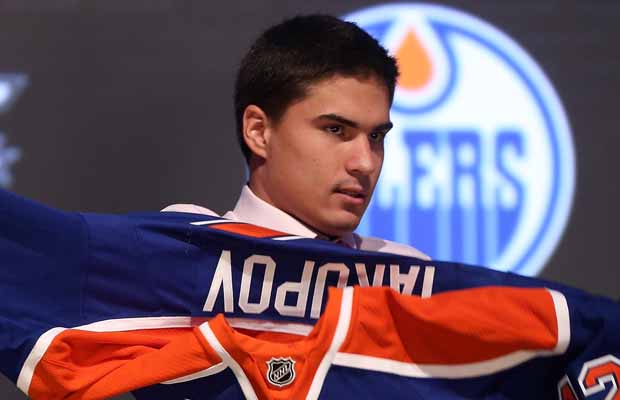
Look, he was almost daring people to question it
The pick succeeded weeks of debate regarding the best course of action for a team full of precocious young talent. Should they add Nail Yakupov to their already stacked forward core? Or should they draft a sorely needed defenseman, even if the full potential of such a pick may not be seen for years?
Then of course there was the multitude of trade options that may or may not have been available. Did teams consider trading a top rearguard straight-up for the #1 pick? Did the Islanders really offer Columbus every pick they had to move up to #2? Did they offer the same to Edmonton?
Who knows? Who cares? The Oilers have Yakupov.
Now the question becomes “How well will he do on a team with this much young talent up front?” He’ll likely start the season on the second line thanks to Taylor Hall’s and Jordan Eberle’s winger status, but he’ll certainly pile up first line minutes during stretches of the season. It will be interesting to see if he plays his way into a defined role early or if he’ll get frustrated with the competition for top ice time and struggle.
That’s just the short term. Looking ahead, will he stay in Edmonton past his rookie contract? Will he ever bail on the NHL like Alexander Radulov? Will he even be good?
History tells us he’ll be just fine.
So let’s get nerdy for a minute.

In this flask contains NHL statistics. *Mcglyvin Hm-ah*
Since the lockout in 2004-2005, all but one top pick (defenseman Erik Johnson in 2006) was used to select a forward. Of those forwards, only the two most recent – Oilers’ Hall and Ryan Nugent-Hopkins – have not made an all-star team (RNH was selected to the all-star rookie squad last year but didn’t play due to injury).
Including Alexander Ovechkin, whose rookie season would’ve been ’04-’05, and Jordan Staal (drafted #2 overall in 2006), here are the season averages of the highest drafted post-lockout forwards:
72.7 Games Played – 32 Goals – 40.7 Assists – 72.8 Points
Pretty stellar. Very stellar considering none of them are older than 26.
Now a wise guy could point out those numbers would be lower if outliers like future Hall-of-Famers Ovechkin and Sidney Crosby weren’t included in that list. That wise guy would be right. He’d also be an asshole.
So let’s go further back in time (or is it farther? Einstein never really explained the grammatical rules of the space-time continuum).

“How far back in time, Doc?”
To 1997 Marty.
Joe Thornton is the last active forward to be drafted 1st overall. Since then only Johnson and goaltenders Marc-Andre Fleury (2003) and Rick DiPietro (2000) obstructed a forward sweep of top overall picks. So counting Jordan Staal and #2 overall selections Eric Staal (2003) and Dany Heatley (2000), here are the season averages since 1997:
74.5 Games Played – 30 Goals – 38.8 Assists – 68.6 Points
Still Awesome. If you tell me Yakupov will pot 30 goals and nearly 70 points every season I’d say “да, то просьба.”
(That’s “yes, please” in Russian… no big deal)
I know, I’m assuming he’ll play in Edmonton a long time. Apropos of history, it doesn’t say he will. But for argument’s sake just go with it.
Now just for fun, let’s go back even further. Let’s go to 1969.

Now you’re just getting crazy
It was the first year when anyone between 17 and 20 could be drafted (today it’s 18-20). Rejean Houle starts the list, and it includes Wendel Clark who was drafted as a defenseman in 1985:
67.8 Games Played – 25 Goals – 34.9 Assists – 59.9 Points
Not bad. That’s including superstars like Blair Chapman and Brian Lawton (who?). However, it also includes 6 HOFers like Guy Lafleur, Mario Lemieux and the recently inducted Mats Sundin.
On a more basic level, the top retired guys on the list of #1 forwards played an average of 13.5 seasons in their careers.
Sign me up.
If Yakupov gives the Oilers over a decade of above-replacement play at a reasonable price then so what if it’s not HOF calibre? It’s why people who bash Chris Phillips going #1 in 1996 don’t really know what they’re talking about.
Of course, the above breakdowns don’t include other stats which help indicate a player’s true worth. Plus/minus, hits, face-offs, penalty minutes, ice time et al. will be some of the statistical categories used to judge Yakupov’s early campaigns.
Furthermore, they’re not even Yakupov’s stats. He could be better or worse than these averages.
They also include the players’ entire career stats. If Yakupov struggles in his first couple seasons it doesn’t mean he’ll end up a bum.

Or worse…
But it’s easy to want gaudy stats, and judging by recent history it’s easy to see why. We’ve been spoiled.
Ovechkin, Crosby, Patrick Kane, Steven Stamkos and John Tavares were all drafted in the last 10 years.
These days top picks seem to be virtual locks to have fast, all-star starts to their careers. Couple that with Yakupov’s style and skill set and I understand the high expectations.
I know I’ll be in the minority if I’m giving Yakupov a pass should he post mediocre rookie or sophomore numbers.
But that shouldn’t happen. History says he’ll be good – soon and throughout his career.
And history is always right…
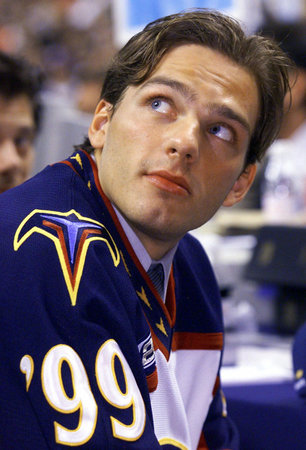
…Except that time
 Enjoy the Ride
Good stuff Lando! I have high hopes for Yakupov.